
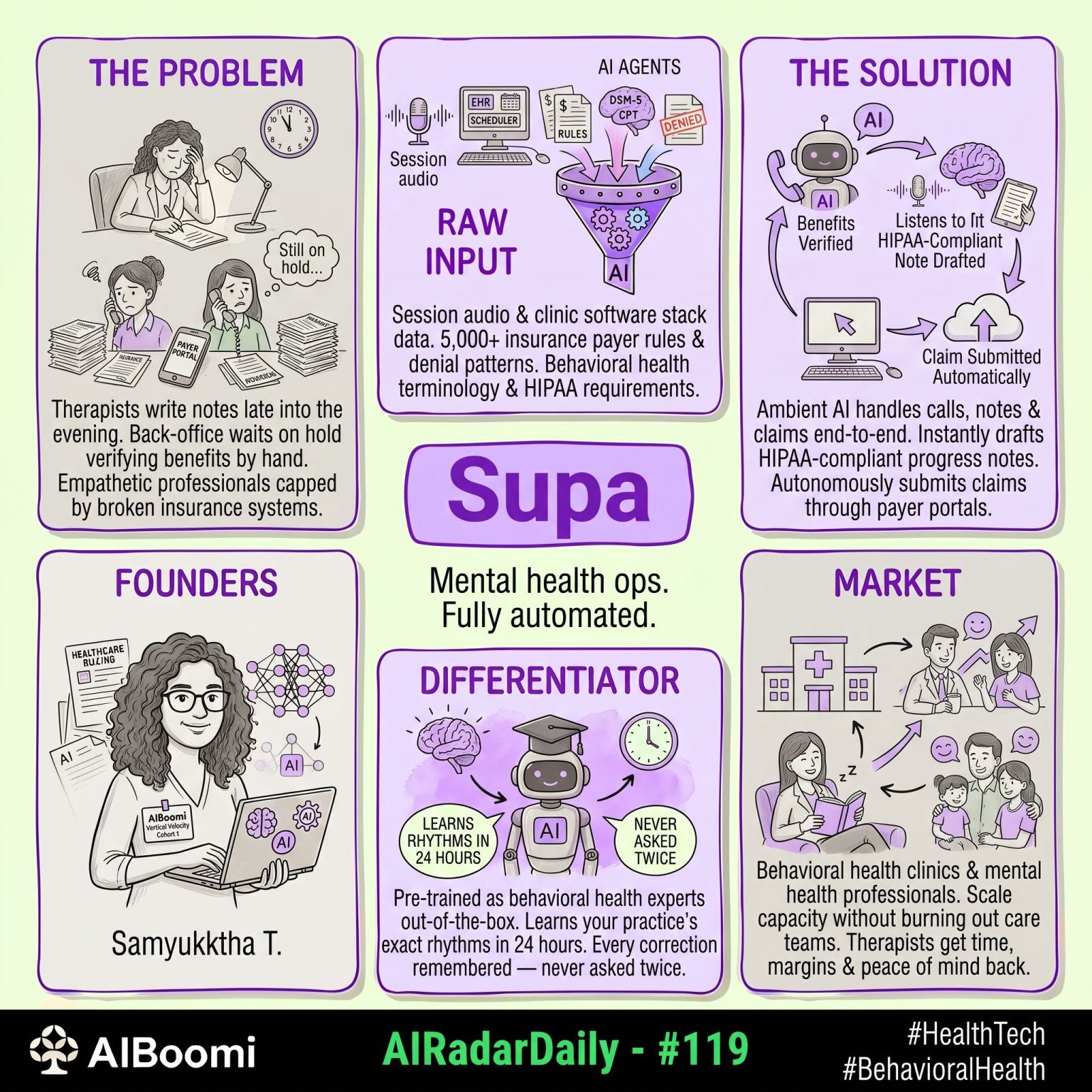
There is a quiet, exhausting reality inside almost every mental health practice. The demands of behavioral healthcare are growing exponentially, yet the infrastructure behind it remains deeply broken. Clinicians are forced to spend hours between sessions and late into the evening writing detailed progress notes instead of recharging. Meanwhile, back-office teams spend their days waiting on hold with insurance payers, verifying benefits by hand, and chasing denials months after a visit. We are asking deeply empathetic professionals to act as human APIs for broken insurance systems, fundamentally capping the number of patients they can actually help.
It takes builders with deep operational empathy and technical rigor to look at this overwhelming bottleneck and decide to systematically untangle it. That is exactly what Samyukktha T. and her team are doing with Supa.
Founded in 2025, Samyukktha is building a deeply intelligent, agentic operating system purpose-built exclusively for the behavioral health market.
The engineering under the hood is transformative. Supa deploys ambient, autonomous AI agents — across front-desk, documentation, and billing — that seamlessly log into a clinic’s existing software stack. These agents handle the full operational loop: they answer calls, verify benefits, listen to sessions to instantly draft HIPAA-compliant, clinician-ready progress notes, and autonomously submit claims directly through payer portals.
The true moat here is deep domain specificity and continuous learning. Supa agents are pre-trained out-of-the-box as behavioral health experts, natively understanding the complex nuances of mental health terminology, 5,000+ payer rules, and specific denial patterns. They don’t just execute tasks; they learn the exact rhythms of a specific practice in 24 hours, meaning every approval, rejection, and correction is remembered and applied next time without ever being asked.
The market? Behavioral health clinics and mental health professionals who desperately need to scale their capacity to care without burning out their clinical and administrative teams. By automating the invisible work of running a practice, Supa gives therapists their time, their margins, and their peace of mind back.
Samyukktha and the Supa team were part of the inaugural AIBoomi (formerly SaaSBoomi) Vertical Velocity cohort. They know what it takes to escape the gravity of building from a distance, and seeing our homegrown founders quietly rewrite the playbook for mental health operations is profoundly inspiring.
Every founder dreams of reaching orbit. Sometimes, all it takes is the right launch window. If you are building an AI-first healthcare startup and looking to experience the US market firsthand, applications for Vertical Velocity Cohort 2 are now live: https://lnkd.in/gnBbkA7g
Let’s celebrate the builders.
w/ Jay Ingle