
// Tagged with AI-first Entrepreneurs
When everything you learned in the SaaS playbook stops working, your board asks about AI, and you have 6 months of runway. A framework for thinking clearly when there are no clear answers.
Who this is for and why now
Let me paint a picture.
You have Rs XX Cr ($X M) ARR. A 40-person team. Solid retention numbers. Customers who trust you. A product that works.
Then your seed investor asks in the quarterly call: “So, when’s the AI pivot happening?”
Your engineering lead wants to rebuild everything on agents. Your sales team says customers don’t understand AI & tokens. Your burn rate gives you 6 months of runway. Every decision feels existential, & unfortunately, you & your co-founder were not born in the AI Native Era.
Welcome to building in the middle
This is the reality for thousands of founders right now. You have working revenue, stable customers, and a team that knows the playbook. But the board/investors keep asking, “What’s your AI story?”
Technology shifts faster than your planning cycles can accommodate. Competitors are rebuilding from first principles while you’re patching features onto legacy systems.
Your team is split down the middle. Half want to defend the core business. Half want to chase the AI future. Both are right. Both are wrong.
Here’s what I’ve learned building ExtraaEdge through this exact transition: In this environment, the real competitive edge isn’t data, models, or capital.
It’s clear thinking under extreme uncertainty at the founding team level.
Shane Parrish puts it simply: “The greatest aid to judgment is starting from a good position.”
Indian founders now sit just 6 to 12 months behind Silicon Valley in the AI race. Not a decade, like the SaaS era. This compression makes clear thinking more critical than ever. The window for course correction is shorter. The stakes are higher. The playbook is being written in real time.
This is not a playbook with answers. It’s a 4-part framework for thinking when there are no answers yet.
Part 1. What do we mean by “uncertainty”?
Let’s ground this word before we go further. Because “uncertainty” can feel like a vague monster. Something that haunts your Sunday evenings but never takes a clear shape.
It’s not. It’s actually quite workable once you understand its structure.
Three regimes of decision-making
Certainty is when cause and effect are stable. Outcomes are predictable. Think of mature SaaS unit economics at scale. You know that if you spend X on acquisition, you’ll get Y customers with Z lifetime value. The math works.
Risk is when outcomes are uncertain, but the possibilities and probabilities are known. You can model CAC variance, churn bands, and A/B test results. You don’t know exactly what will happen, but you can assign probabilities to different outcomes.
Uncertainty is different. You don’t know all possible outcomes. You can’t assign meaningful probabilities. The future contains scenarios you haven’t even imagined yet.
Most of what AI-era founders face falls into this third category i.e. Extreme Uncertainty
Consider: Will India’s Digital Personal Data Protection Act reshape AI product development? Will GPT-5 cost 10x or 0.1x what GPT-4 costs today? Will open source models catch up to closed ones? How will customer expectations evolve when everyone has access to the same foundation models?
These aren’t risk questions. They’re uncertainty questions. And they require different tools.
The Rumsfeld matrix: four modes of uncertainty
Donald Rumsfeld caught flak for his “known unknowns” framework, but it remains one of the most useful mental models for navigating uncertainty.
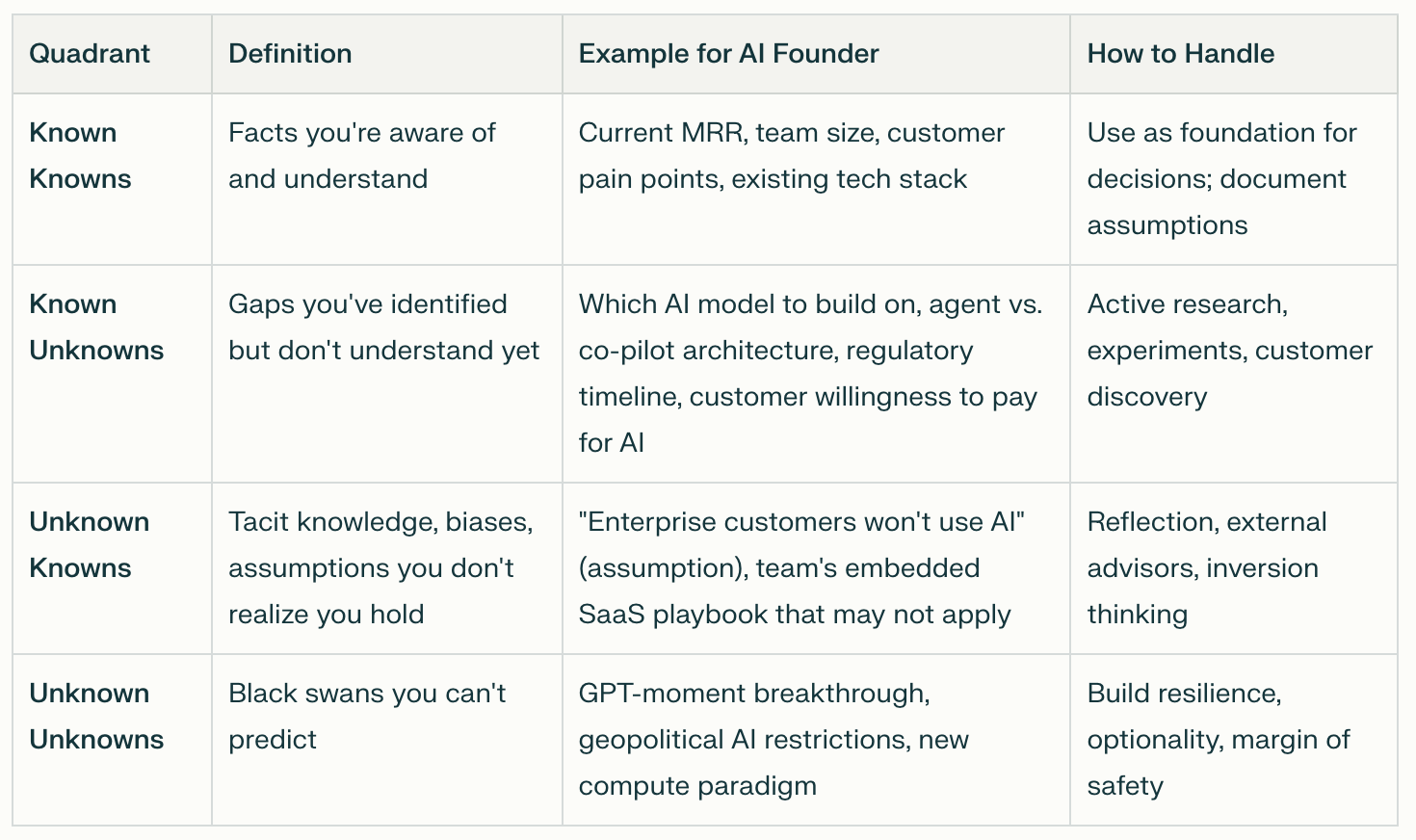
Here’s the uncomfortable truth: Most startup tools were designed for risk, not uncertainty.
OKRs assume you can set measurable objectives. Budgets assume you can forecast spend against outcomes. Roadmaps assume you can sequence work toward a known destination.
In the SaaS era, you could model CAC payback periods, LTV curves, and retention cohorts. The math was hard but knowable.
In the AI era, the model layer changes monthly. Customer use cases are still emerging. Value capture mechanisms remain unclear. “Should you build on OpenAI, Anthropic, or open source?” isn’t a risk question with calculable probabilities. It’s an uncertainty question where the possible states keep shifting.
A prompt for you: Take 60 seconds right now. Which decisions in your company are still in “risk” territory, where you can model probabilities? And which have moved into true “uncertainty” territory, where you cannot assign meaningful probabilities? Write down 3 of each.
The key insight here is that recognizing the type of uncertainty changes how you think. Known unknowns demand research and experiments. Unknown unknowns demand resilience and optionality. Unknown knowns demand reflection and the courage to challenge your own assumptions.
Part 2. The struggle: what founders face under extreme uncertainty
Ben Horowitz wrote about “The Struggle” years ago, but it hits different when you’re living through a platform shift.
The Struggle is not an exception. It’s the norm when business models and technology shift simultaneously.
“The Struggle is not failure, but it causes failure. Especially if you are weak.”
What The Struggle Looks Like Today
The Struggle is when your best engineer says “We should rebuild everything as agents” but you have paying customers on the current product who didn’t ask for agents.
The Struggle is when employees think you’re lying about the AI roadmap. And you think they may be right.
The Struggle is when VCs ask about your moat, and you realize that data and workflows, the things that protected you in SaaS, might not matter anymore when every competitor has access to the same foundation models.
The Struggle is when food loses its taste because you’re calculating burn rate against AI development timelines in your head during dinner.
Horowitz nailed this feeling: “The Struggle is when you don’t believe you should be CEO of your company. The Struggle is when you know that you are in over your head and you know that you cannot be replaced.”
Why this is different from normal startup hard
Normal startup hard is product-market fit. Hiring. Fundraising. These are known unknowns. Hard, but mappable.
AI transition hard is when the playbook itself becomes uncertain.
Do you charge per seat or per outcome? Do you build a copilot that assists humans or an autonomous agent that replaces workflows? Do you sell productivity improvements or business transformation? Is your edge the model, the data, the workflow, or the distribution?
These aren’t just hard questions. They’re questions where the right answer might change quarterly.
The psychological dimension
Research on decision-making under uncertainty shows consistent patterns. Decision fatigue compounds when every choice feels consequential. Cognitive load spikes when your mental models from SaaS don’t transfer cleanly. Imposter syndrome whispers: “Am I even technical enough for the AI era?”
Analysis paralysis sets in because every decision feels irreversible.
But here’s what I find useful: Studies of emergency medicine physicians show that experienced doctors use uncertainty as a trigger to focus cognitive resources, not as a signal to freeze. They’ve trained themselves to recognize uncertainty and lean into it rather than away from it.
That’s learnable. That’s the craft.
Horowitz’s survival strategies, adapted for AI founders
1. Don’t Put It All On Your Shoulders
Share the uncertainty with your founding team, advisors, even select customers. Horowitz’s advice: “Get maximum brains on problems even if problems represent existential threats.”
Build a kitchen cabinet of 3 to 5 people who’ve navigated platform shifts before. Not mentors who give generic advice. People who’ve felt this specific weight.
2. This Is Chess, Not Checkers
“There is always a move.”
When you think you’re stuck between “rebuild everything” and “keep iterating on legacy,” there’s almost always a third option. A hybrid architecture where new features run as microservices on AI while the legacy system continues serving current customers. A parallel track that doesn’t bet the company.
The move exists. Your job is to find it.
3. Play Long Enough to Get Lucky
“Tomorrow looks nothing like today.”
In 18 months, model costs may drop 90%. New monetization models will emerge. Regulations will clarify. Customer expectations will stabilize into patterns you can design for.
Your job isn’t to have all the answers now. Your job is to survive with optionality intact.
4. Don’t Take It Personally
You made decisions with the information you had. Self-evaluation that grades yourself an “F” doesn’t help anyone.
Horowitz reminds us: Both the hero and the coward feel the same fear. The difference is action.
The Struggle is real. It’s also where every great company is forged.
The question isn’t “How do I avoid The Struggle?” The question is “How do I think clearly within The Struggle?”
Part 3. How others think clearly under extreme uncertainty
Clear thinking under uncertainty isn’t a personality trait. It’s a skill. And some domains have been developing this skill under life-and-death pressure for decades.
Military decision-making: The OODA loop
John Boyd was a fighter pilot who later became one of the most influential military strategists of the 20th century. His framework, developed for pilots making life-or-death decisions in seconds, has lessons for every founder navigating uncertainty.
OODA stands for:
- Observe: Gather information from your environment. Market signals, customer feedback, technology landscape, competitive moves.
- Orient: Analyze what you’ve observed in context of your mental models, experience, and culture. This is where most founders get stuck, using SaaS mental models for AI decisions.
- Decide: Choose a course of action as a hypothesis, not as certainty. This framing matters.
- Act: Execute, then gather feedback that becomes input for the next cycle.
Three insights for founders:
First, speed through the loop beats speed of individual decisions.
Boyd’s insight wasn’t about making faster decisions. It was about completing more decision cycles than your opponent. The founder who ships an AI feature, learns from usage, and iterates weekly will beat the founder who spends six months perfecting before launch.
“The leader who moves through the OODA cycle quickest gains advantage by disrupting the enemy’s decision-making.”
Second, the framework assumes incomplete information.
Boyd designed OODA for situations where you’d never have complete information. That’s the whole point. Train yourself to decide with 60 to 70 percent confidence, then learn fast. Military training deliberately bombards leaders with contradicting information and forces decisions without complete data. Because that’s reality.
Third, the loop has evolved.
Modern military thinking has added nuance. Discovery (enhanced observation). Design (strategic planning with complexity awareness). Decide (hypothesis with explicit risk consideration). Disseminate and Monitor (communication plus continuous assessment).
How to apply this:
Set trip wires. “If our AI feature doesn’t hit X usage in 90 days, we pivot to approach B.” This removes the emotional weight of the decision in the moment.
Use commander’s intent. “Our goal is autonomous workflows for customer success teams. How you get there is flexible.” This empowers your team to make decisions without escalating everything.
Run weekly decision reviews. What did we learn? What hypothesis did we test? What do we believe differently now?
Emergency medicine: thinking clearly in trauma
Emergency department physicians make high-stakes decisions with incomplete information, time pressure, and lives on the line. Every shift. Their profession has studied how to do this well.
Two strategies that transfer:
Pattern recognition plus staying open.
Experienced physicians use pattern matching for rapid initial assessment. They’ve seen enough cases that certain combinations of symptoms trigger immediate hypotheses.
But here’s what separates good from great: they actively remain open to alternative hypotheses as new data emerges. They hold their initial read loosely. They update when the evidence demands it.
For founders, this means: Use your SaaS pattern recognition to generate hypotheses about AI strategy. But hold them loosely. Update aggressively when customer behavior tells you something different.
Explicit uncertainty acknowledgment.
Emergency medicine has developed formal protocols for acknowledging uncertainty out loud. “I’m not sure if this is X or Y, so we’re going to monitor for these specific signals.”
This isn’t weakness. It’s clarity. It focuses the team on what to watch for. It creates shared understanding of the decision landscape.
Try this in your next strategy discussion: “I’m 60 percent confident in this direction, and here’s what would change my mind.” Watch how it shifts the quality of the conversation.
Part 4 – Where we go from here
Building in the middle is exactly as hard as it sounds.
You’re not a fresh startup that can pivot without consequence. You’re not an incumbent with years of runway and diversified bets. You have customers counting on you, a team that joined for a specific mission, and investors expecting a specific outcome.
And the ground beneath all of it keeps shifting.
But here’s what I’ve come to believe: The founders who thrive through platform shifts aren’t the ones who predict the future correctly. They’re the ones who build the capacity to think clearly when prediction fails.
That means understanding what kind of uncertainty you’re actually facing. It means accepting The Struggle as the territory, not as a sign you’re doing it wrong. It means learning from domains that have practiced high-stakes decision-making under uncertainty for generations.
The tools exist. The frameworks exist. The path through exists.
This is the first piece in a series. We’ll go deeper on specific frameworks, share stories from founders navigating this transition, and build a practical toolkit for thinking clearly when the map keeps changing. And changing faster than we have ever seen!
If you’re building in the middle, you’re not alone. Let’s figure this out together.
// Tagged with AI-first Entrepreneurs