
// Tagged with Advantage India
Every AI pitch deck has the same slide.
Headcount flat, revenue up and to the right, margins expanding as the models improve.
Attentive.ai raised $48 million with the opposite chart.
The company sells takeoff software to construction contractors. AI reads blueprints and extracts quantities.
Then a human checks the output before it reaches the customer.
Every single time. That labor line never goes away, and over one thousand contractors pay an average of $20K a year for it.
By the standard VC playbook, this is a consulting business wearing a SaaS costume. It requires ongoing labor. It scales with headcount.
It should not have cleared a Series B.
It did, and the reasons are worth studying because they contradict how most AI founders are building right now.
Blueprints broke the automation dream
Construction blueprints have no standard format.
Architects invent their own notation. Trades use symbols that contradict each other.
The same wall can appear three different ways across three drawings on the same project.
Founder Shiva Dhawan puts it plainly: “Blueprints are not standardized. Every project differs in symbols and annotation conventions, drawing styles across architects, level of detail and noise, and trade-specific layouts and schematics.”
That is a completely different data problem from consumer AI.
There is no corpus of a million identical examples. Every input is a one-off with its own quirks and noise. Run full automation on data like this and you get confident, wrong numbers.
And a wrong quantity in a bid costs a contractor real money, sometimes the whole job.
So Attentive stopped chasing full automation.
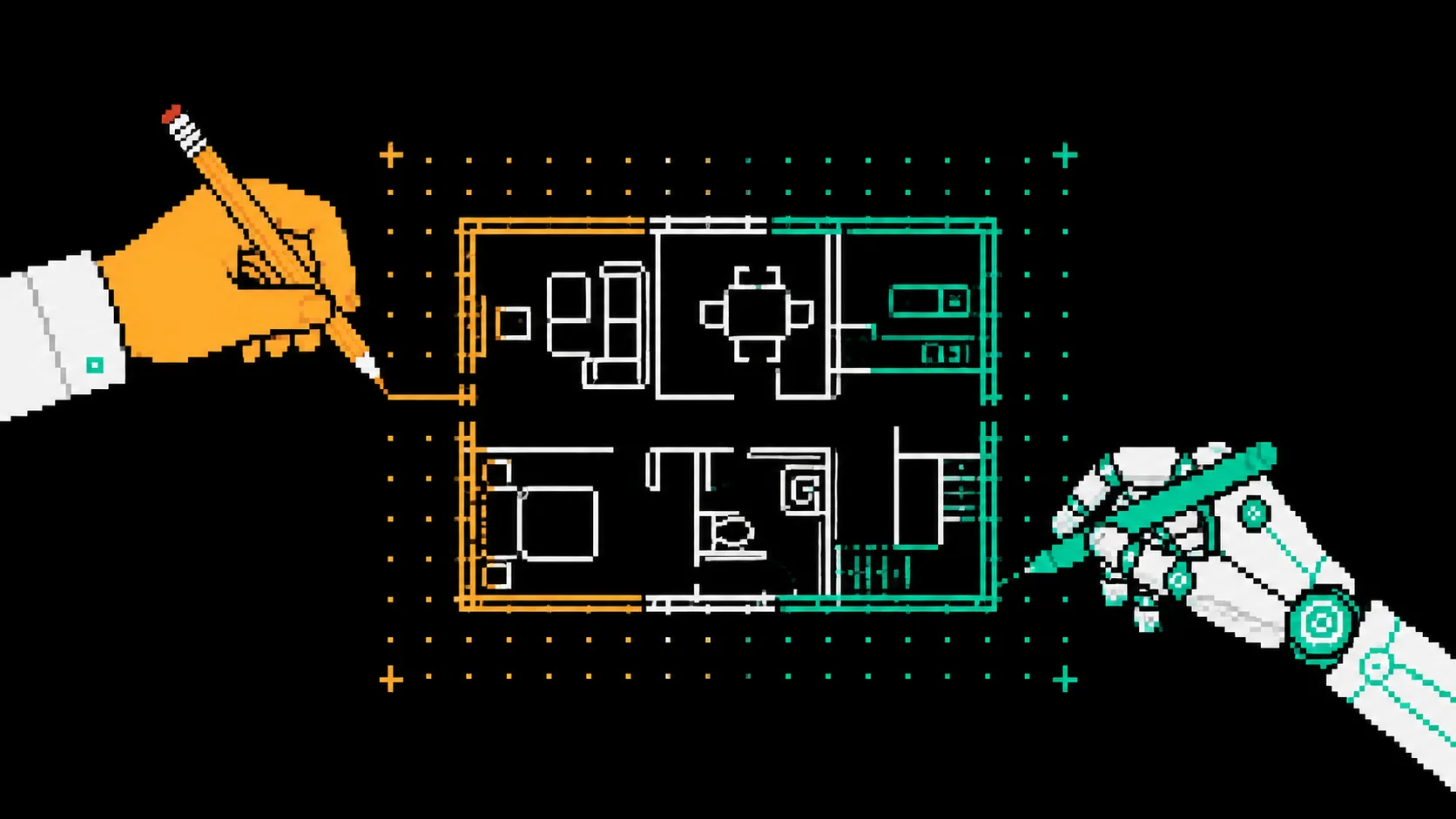
Instead, AI extracts the structured data, humans resolve the ambiguity, and the deliverable is contractor-grade every time.
The metric they track internally is telling. They measure how fast turnaround time drops, quarter over quarter, as the models improve.
What percentage needed human fixes is an internal cost detail, invisible to the customer.
The $500 question
Ultimately, the essence of every company can be captured with math. In the case of Attentive, most coverage of the company completely glosses over this aspect.
Human verification costs roughly $500 per takeoff.
At $20K ACV, with customers running multiple projects a year across long engagements, that cost sits comfortably inside the contract.
Drop the ACV to $2,000 and the same architecture eats the entire customer lifetime value.
Human-in-the-loop works at specific price points and fails everywhere else.
Attentive found one where it works.
That’s the whole trick, and it’s more useful than any egalitarian theory about humans and machines.
Early on they went further and sold manual takeoff services alongside the software, taking the margin hit on purpose.
Dhawan: “Early on, unit economics were pressured because we started with a manual takeoff service component to guarantee quality and accelerate adoption. But this was intentional. It created trust, generated training data, and allowed us to enter workflows immediately.”
The underrated part is what happens to pricing over time.
A fully automated product gets cheaper for everyone, fast.
Competitors match the capability, efficiency gains flow straight to the customer, and you’re in a price war within two years.
A human-verified product holds its price because the customer is buying a guaranteed deliverable.
Meanwhile the labor cost behind that guarantee keeps shrinking as the models improve. The customer sees the same output. The vendor keeps the spread.
Margin expansion without ever cutting price.
Bluebeam can’t follow
Bluebeam is the 800-pound gorilla in the market that Attentive plays in – it owns construction document workflows. PDF markup, collaboration, a plugin ecosystem wired into every contractor’s process. Deeply embedded, genuinely good at what it does.
But the key tell is in the incentive.
Bluebeam bills for seats.
Those seats exist because estimators spend hours counting objects and tracing lines inside Bluebeam.
Automate the takeoff and the seats start disappearing.
Whatever their engineers are capable of building, the revenue model punishes them for building it.
Dhawan is careful about the framing: “Bluebeam is still the dominant tool for manual takeoffs and PDF workflows. Our focus is fundamentally different. We are looking to eliminate the need for contractors to do takeoffs in-house manually. Contractors choose Beam AI when they want to expand their business, bid on more projects, and stop having estimators spend hours counting objects and tracing lines just to produce quantities.”
Attentive has no legacy seats to protect.
That’s the actual advantage, and it required zero technical superiority.
For founders eyeing other incumbent-dominated markets, the lesson is a screening question: look at what the incumbent’s billing model forbids them from building. That is your whitespace, regardless of how good their engineers are.
Expensive on purpose
Attentive runs separate models per trade, with trade-specific product teams behind them.
Concrete behaves differently from HVAC, which behaves differently from Steel.
Dhawan: “Scaling required trade-specific intelligence. Today, Beam AI includes models and workflows tuned by trade, and we continue expanding coverage systematically. Performance does degrade if you apply a model trained on one trade to an unfamiliar one, which is why modular trade-aware development is core to our roadmap.”
Internally this is pure friction. Redundant work, coordination overhead, slower coverage expansion.
But a generalist competitor now faces an ugly choice: ship one mediocre model across all trades, or spend years rebuilding the trade-specific stack Attentive already finished.
Most founders treat heterogeneity as a bug to engineer away.
Attentive priced it in as the moat.
Sales cycles as training data
There is no product-led growth here.
Inside sales, four to six week cycles, still the primary channel at 1,100 customers.
Dhawan again: “Construction is not a viral SaaS market as it’s workflow-heavy, trust-driven, and contractors don’t adopt new systems casually.” Takeoff errors turn directly into lost bids or margin leakage, so nobody swaps out a working estimation process on a whim.
The clever bit here is the pilot.
Attentive runs takeoffs on the prospect’s own drawings, and the contractor compares the output against what their own estimators historically produced.
Validation happens before the contract is signed.
And every pilot generates training data whether the deal closes or not.
The sales motion feeds the model.
The final uncomfortable question
Now the tension the most funding announcements don’t touch.
Models keep improving.
At some point human review catches almost nothing, and the customer is paying $500 a takeoff for theater.
Contractors are sharp enough to notice, and the economics flip from moat to liability.
Attentive’s own framing leaves the exit door open.
Dhawan’s summary of six years: “The biggest lesson is that we should focus on delivering customer outcomes, which can include a human-in-the-loop component if the unit economics allow for it. Do not obsess over pure AI solutions from day 1.”
We all need to read that carefully.
Attentive is committed to outcomes.
Human involvement rides along only while the economics justify it.
The human layer is infrastructure today and might be scaffolding tomorrow.
A founder willing to say that out loud is arguably rarer than the architecture itself.
There is also a nearer-term payoff hiding in the setup.
Because a human checks everything, Attentive ships model updates without fear.
A bad rollout raises their internal costs and never touches the customer’s deliverable.
The verification layer doubles as a safety net for their own iteration speed, which means they can experiment faster than a pure-automation competitor who risks customer-facing failures with every release.
Where this travels and where it dies
The company’s Series B money extends the same philosophy across preconstruction: estimating, bidding, collaboration. Estimators freed from counting spend the time on pricing strategy and win rates.
Nothing in the expansion plan mentions eliminating anyone.
The playbook exports to markets that share construction’s shape.
Errors that cost far more than the transaction, the way a diagnostic mistake carries liability or a compliance failure carries fines. Messy, non-standard inputs. Buyers who move slowly because the workflow is mission-critical.
And contract values big enough to absorb a labor line.
Healthcare, legal, insurance, industrial manufacturing all qualify.
It dies in low-ACV markets, and in any domain where inputs are standardized enough that automation genuinely works end to end.
The lesson for all other AI founders has nothing to do with keeping humans in loops as a principle.
Stop deciding your architecture from a philosophy slide.
Attentive picked the outcome first, accurate takeoffs delivered fast, then let the market dictate what it took.
In construction, that means paying humans indefinitely.
In your market, it might mean something else entirely.
Find out before you commit to the elimination chart.
// Tagged with Advantage India