
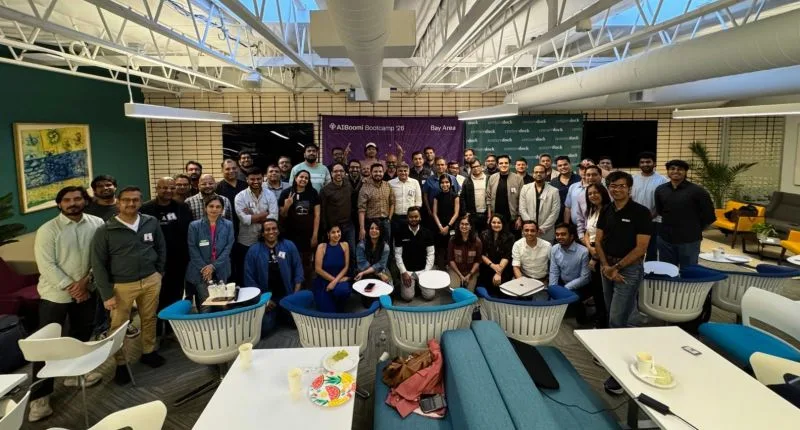
When we first started discussing the idea of taking an AIBoomi Bootcamp to the Bay Area, it felt ambitious for the timeline we had.
- A 40 day window right after our Annual event
- Most of the core team in India.
- A new format.
- And a room we wanted to curate with care.
But sometimes, the best community experiences are built exactly like that: slightly chaotic, deeply collaborative, and held together by people who care more about the outcome than the odds.
Last week, we wrapped up the first AIBoomi Bootcamp Bay Area edition. And somehow, it became exactly what we had hoped for.
Not a conference, or another AI hype gathering, or even a room built for logos.
A room full of builders.
Why we designed it this way
Right after Annual, we knew we did not want to immediately jump into another large-format event. The ecosystem already has enough conferences. What felt more useful was something smaller and more intentional- especially when AI conversations are moving faster than most people can process.
So we designed the Bootcamp as three half-days! The idea was simple: founders are working operators. They have teams to run, customers to speak to, investors to manage, and products to ship. A half-day format gave them enough space to work and still come into the room with energy.
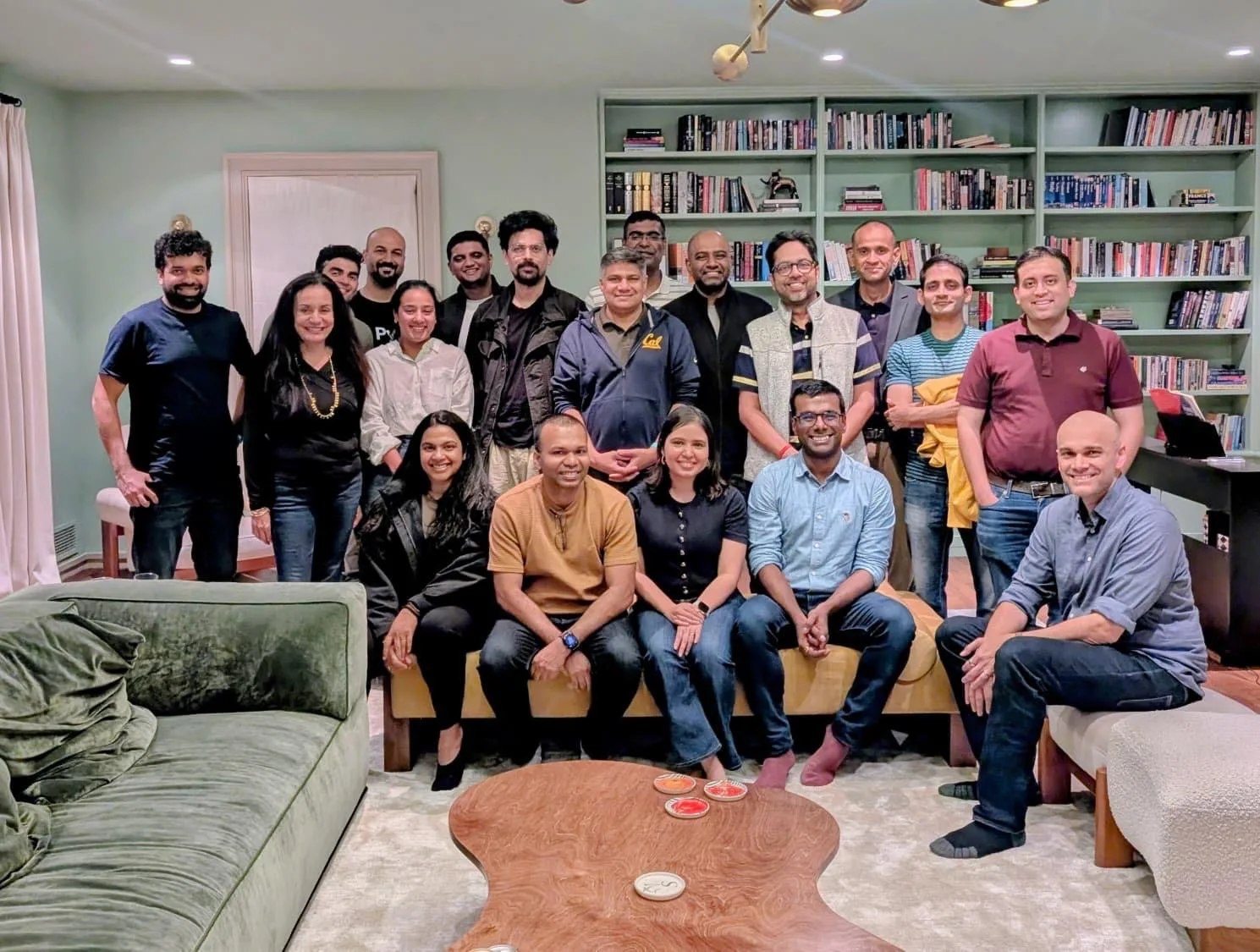
We planned for around 60-70 curated founders. That is almost exactly who showed up. In hindsight, that number mattered. Big enough to create energy. Small enough for people to be honest.
“Ghar ke log hain”
For anyone who knows me even a little knows that I still get stage fright before getting on stage. Just a few minutes before we started, Avinash asked me how I was feeling, and I told him honestly: “I’m nervous.” He just smiled and said, “Sab ghar ke log hain.”
These are our own people. This is family.
And somehow, that one line completely settled the room for me. It also ended up becoming the feeling of the entire Bootcamp by the end of those three days.
There were founders from India, the Bay Area, Seattle, Chicago, New York, Singapore, Canada and beyond. Some were just getting started. Some were rebuilding companies in real time. Some were scaling fast. But the tone in the room stayed grounded. Just builders trying to learn from other builders.
We also started with a reminder that success in life is not only about the startup. It is also family. It is also health. That set the tone in a way we did not fully anticipate. It made the conversations more human.
The big theme: everyone is unlearning
Across sessions, one theme kept coming back: AI is forcing founders to unlearn a lot of what worked in SaaS.
Kanav Hasija from MeltPlan spoke about how vertical AI is collapsing time-to-value. In the SaaS era, many “boring” industries never made the full leap because implementation was heavy, behaviour change was hard, and vertical depth was expensive. In AI, founders can meet customers where they already are. The product does not need users to fill endless forms; it can extract, interpret, and act. His point on the 95% accuracy threshold stayed with many people. At 85%, customers are still fixing too much. At 95%, something flips. Trust begins. Adoption changes. Scale becomes possible.
Manoj Agarwal from DevRev brought another sharp lens: in AI, DIY is a real competitor. Earlier, the internal build-vs-buy threshold was much higher. Now, at around $400K, many customers begin asking whether they should build it themselves. His message was clear – product alone is not enough anymore. GTM, deployment, customer success, forward-deployed engineering, reliability, compliance, and the ability to actually make it work in the customer’s environment are becoming the differentiators.
Swapnil from Observe.ai shared what it takes to transform an existing SaaS company into an AI-native one. This wasn’t mere theory. It was painful, operational, and honest. Killing products, changing buyer personas, moving from Ops to CIOs and CTOs, letting go of old ways of working, and rebuilding the company around speed. One of the strongest takeaways was that weekly shipping is not a process change. It is a culture change.
Vijay from Atomicwork pushed the room to think about AI companies as hybrid teams, humans plus AI workforce. His point was simple but uncomfortable: when building becomes easier, judgment and distribution become harder. He spoke about young talent, personal agency, ownership, and the need to build companies that can keep rebuilding themselves as the AI stack changes every few months.
Sri from Rocketlane brought the conversation back to storytelling. Valley companies are very good at telling the story before the product is fully there. Indian companies often have the opposite problem – the product is ahead, but the story is not. His point that “marketing should make the product team a little uncomfortable” got a lot of nods. In a market where categories are shifting and lanes are merging, messaging is not a cosmetic layer. It is strategy.
Patrick Salyer from Mayfield gave a very clear investor lens on defensibility. What will not become just a Claude skill? What has unique insight? What has workflow depth? What has distribution? What has a team that truly understands the problem? His point that investors are not looking for Claude-generated clarity, but founder-earned insight, was a useful reminder for many in the room.
Arjun Pillai’s fundraising session was practical and tactical. Investors do not invest in dots; they invest in lines. The job of the founder is to show momentum, confidence, and progression. Fundraising is not just about a deck. It is about transferring conviction. All in all, a finale that the room fittingly deserved that evening.
One format that consistently worked like it usually does at AIBoomi events were the unconference sessions.
Some of the most honest and high-signal conversations came from founders simply reacting to each other in real time: what humans will still continue to do in an AI-first world, whether boring industries are now the biggest opportunities, how much of the SaaS playbook still survives, and what “true north” even means when the technology stack keeps shifting every few months. There was no stage-performance energy to it. Just founders openly thinking through hard problems together.
Across all of this, the throughline was clear: AI is not just changing products. It is changing company-building itself.
OpenAI, VentureDock, and partners who made the room feel larger
A big part of this Bootcamp was the partners who helped shape the experience.
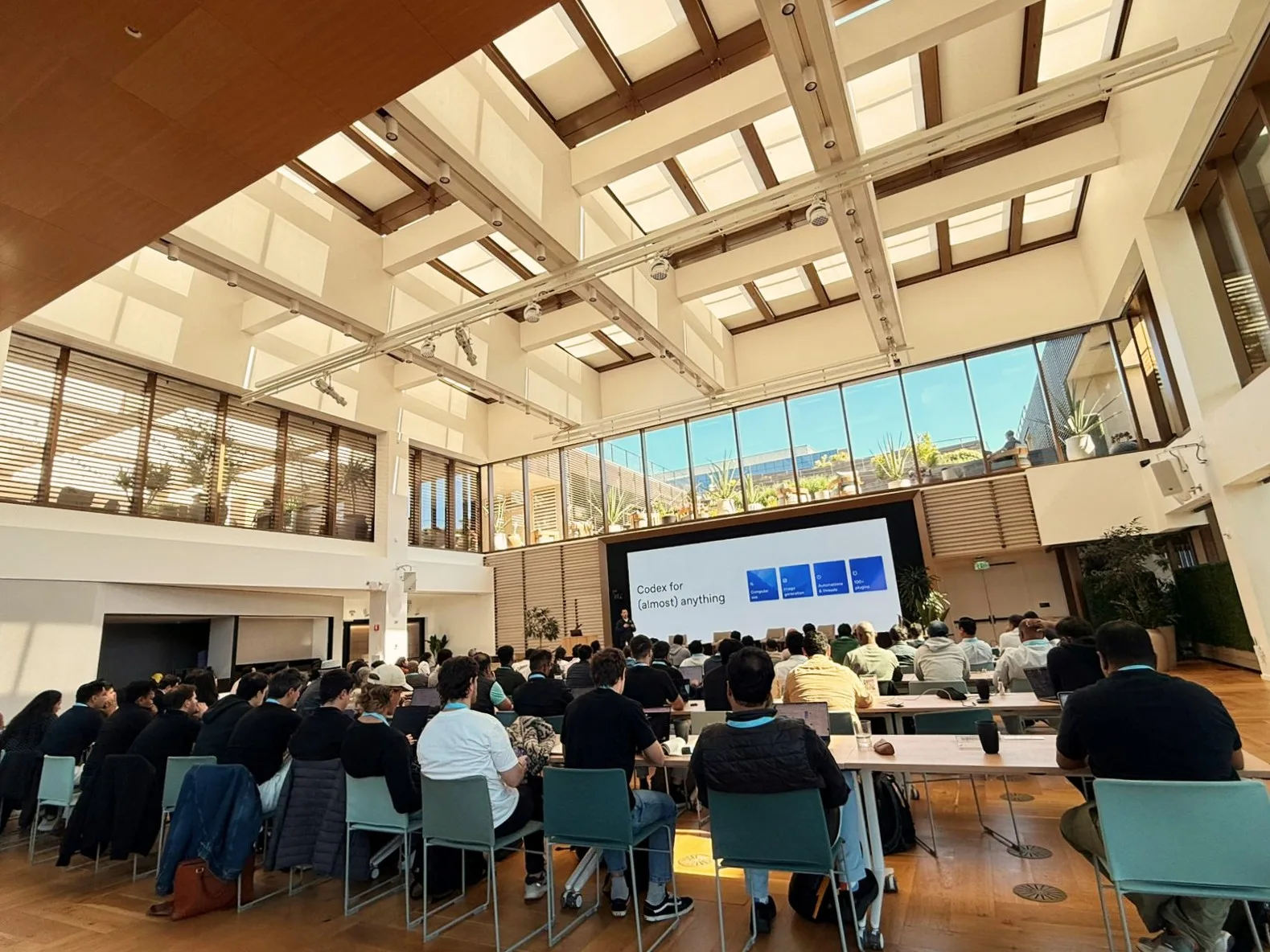
Day 2 at OpenAI was special. The team did everything possible to make the founders feel welcome. There was chai. There was a chaat counter. There was Indian food that many people said tasted better than what they get in India.
But beyond the hospitality, what stood out was the thoughtfulness. The room felt hosted, not just accommodated. For founders who had travelled from different parts of the world, those small details mattered.
Day 3 with VentureDock brought a different kind of energy – intimate, practical, and deeply aligned with the spirit of the Bootcamp. It gave the founders space to continue the conversations in a setting that felt collaborative and grounded.
We were also fortunate to have two sponsors – PromptQL and Cooley, who came in early and backed the format. For a first edition, that trust mattered.
The conversations outside the sessions mattered just as much
The formal sessions were only one part of the Bootcamp. The real magic was often in the in-betweens – over chai, during breaks, after sessions, in side conversations, and in founders comparing notes honestly.
How do you pick the right first customers?
Should you go mid-market before enterprise?
When do you move to the US?
What does founder-led sales look like in AI?
How much of the SaaS playbook should be thrown away?
These were not abstract questions. These were active problems that founders were living through.
That is what made the room high-signal.
A volunteer-led effort across continents
What still feels slightly unreal is how much of this came together across time zones. The team in India, volunteers in the US and Canada, speakers, partners, sponsors, and on-ground supporters all pulled different parts of it together: content, logistics, founder coordination, partner management, registration, session design, hospitality, and all the invisible work that never shows up in photos.
We will acknowledge everyone properly, because this would not have happened without them.
Community work often looks effortless from the outside. In reality, it is powered by people gesturing, “I’ll take care of it,” again and again.
What the feedback told us
As the feedback started coming in, one thing stood out. No detractors. Not one!
That does not mean everything was perfect. We have plenty of learning. There are things we will tighten, rethink, and improve.
But it does tell us something important.
There is a real appetite for curated, founder-first AI conversations that are honest and relationship-driven. Not overly polished. Not overly commercial. Not built for vanity metrics.
Just high-trust rooms with the right people.
On to the next one
The Bay Area Bootcamp was our first edition. It will not be the last!
We are carrying the learnings from this straight into what comes next – Caravan – with dates to be announced soon.
If this Bootcamp taught us anything, it is that when the right people come together with the right intent, even a room of 60-70 founders can create disproportionate energy. And in the middle of all the noise around AI, maybe what founders are really looking for is not another event.
Maybe it is a room where they can be real.
To everyone who showed up, shared openly, hosted us, backed us, volunteered, and trusted us with your time, thank you.
This one felt like family. In every way possible.