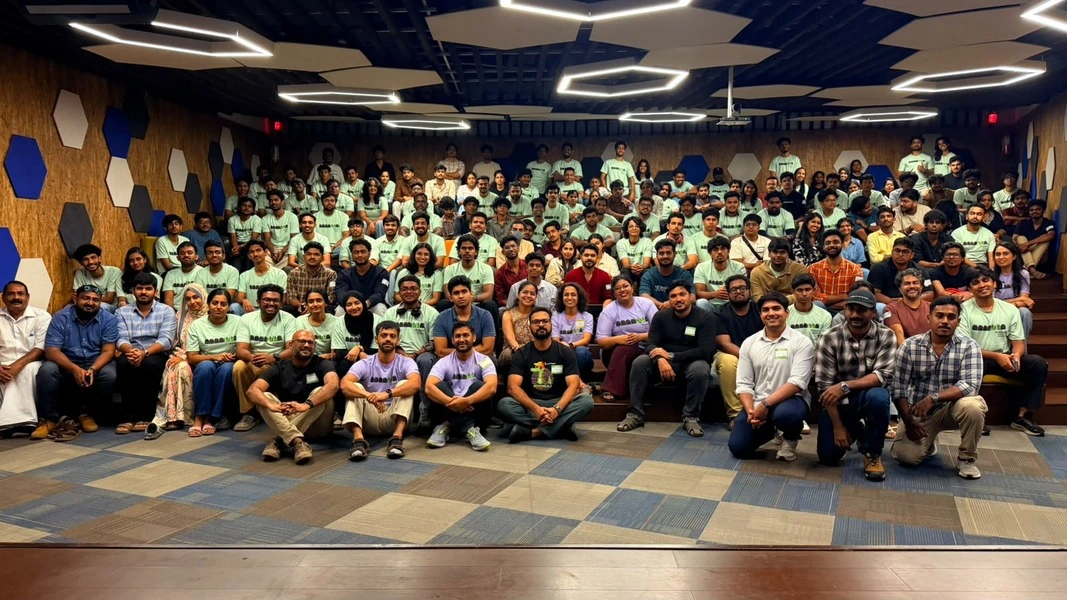
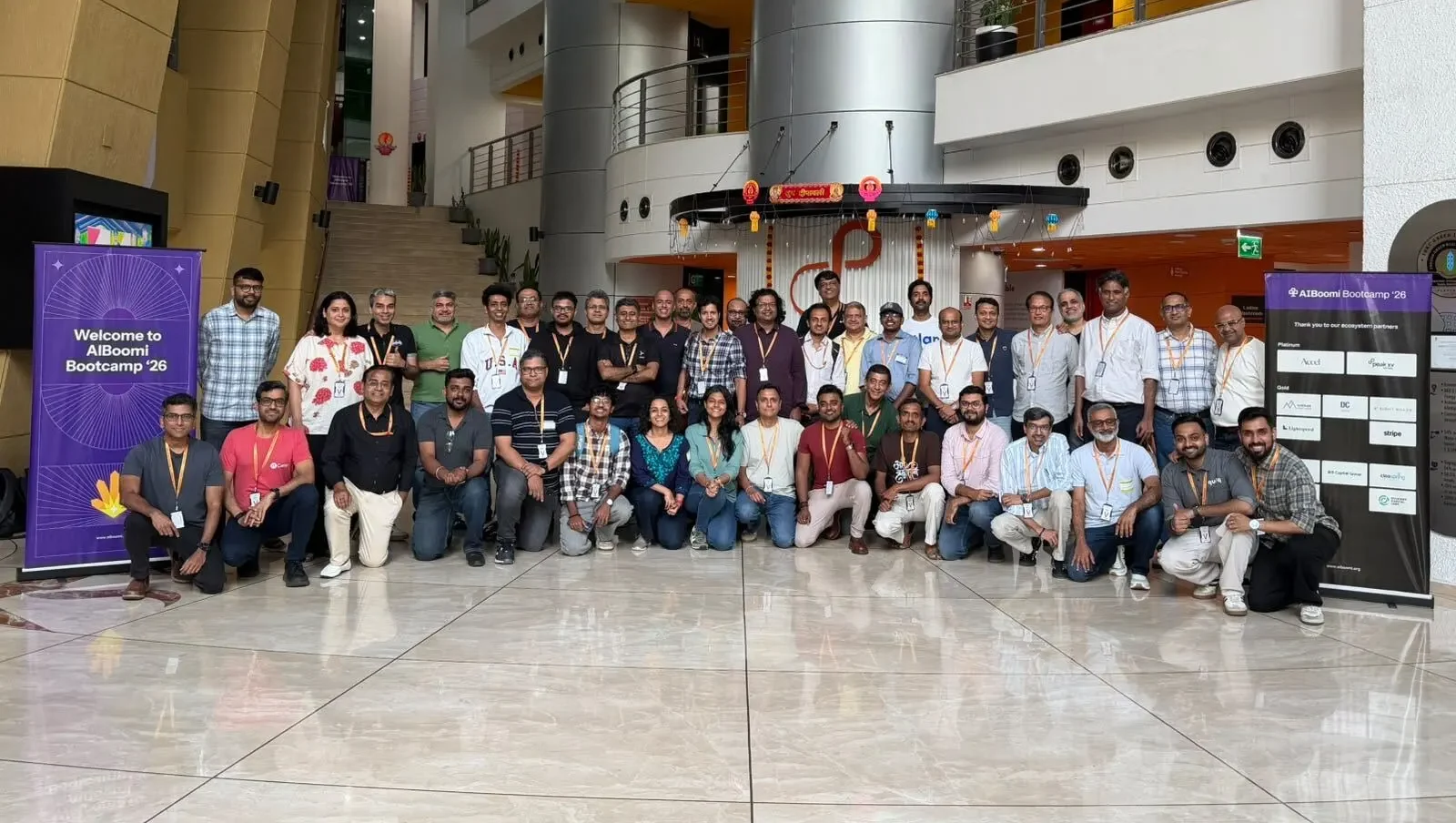
AIBoomi Pune Bootcamp ’26 gathered founders at Persistent Systems for two days (October 30 and 31) of open Q&As and conversations that kept spilling past their scheduled endings. It was my first multi-day, in-person event outside Bengaluru, and I held two vantage points at once: the organizer with a radio in hand, and the observer listening from the edges of the room.
This is my take on both.
A room that declined to perform
Most conferences are built around the podium: a speaker, a slide, a polite round of applause. This one worked differently. Speakers shared their experiences, took questions mid-session, and let the conversation wander wherever the founders’ curiosity led. More than once, a talk was interrupted by someone asking, “Wait, how exactly do you run that?”
The speakers answered with unusual generosity. They described how their companies operate day to day: what they tried, what broke, and what they would change. Nobody was selling a vision of the future. They were showing their workings, and founders responded with candid questions rather than rehearsed ones.
What an early-stage founder can borrow
I kept asking what a founder at the zero-to-one or one-to-two stage could take from these rooms and use the following week, without a large team or budget.
Start with yourself. Abhishek Ballabh of Vidya AI argued that a founder should become the most capable AI user in their own company before asking anyone else to follow. His own days run on a personal system he built for himself first. The company’s habits, he suggested, follow the founder’s.
Let the company run on AI, not just ship it. Nitin Gupta of FlytBase described a team where people outside engineering build and ship real tools, and where the organization learns faster than anything can attack it. Ashwini Asokan and Anand Chandrasekaran, building their second company- Vulkan AI, showed how a young team can turn a single customer conversation into organized, actionable work almost immediately. For a small team, the message was liberating: you do not need scale to work this way. Being small is the advantage.
Advantages, not moats. Monish Darda of Icertis and Rishen Kapoor from Peak XV, spoke candidly about defensibility when anyone can build anything. Their conclusion was sobering and oddly freeing: permanent moats are rare now, and what founders hold are advantages that must be developed, used fully, and renewed. The goal is no longer to build a wall, but to keep moving.
Selling must still be learned. Anand Deshpande of Persistent Systems opened the event with a reminder that technology can be bought, but your context and data cannot. Monish later brought three decades of enterprise experience to life through stories of patience, personal touch, and the long game. Surendran Balachandran offered a grounded view of growth and Brijraj Bhuptani of Spry reminded us to begin with what actually moves the customer’s business.
Govern what you build. A quieter thread ran beneath it all. Speed without oversight compounds risk as efficiently as it compounds output. Founders were urged to know what their agents are doing, and who they answer to.
More than networking: comprehension
Between sessions, I had the chance to speak candidly with founders during the breaks. A sentiment came up repeatedly: smaller, multi-day gatherings like this one make it far easier to understand one another. When a group is intimate and the format gives conversations time to breathe, people go beyond exchanging cards. They learn what their peers are building, how their workflows actually run, and why certain decisions were made.
Several founders described it as a different kind of value from a typical networking event. It was less about meeting people and more about comprehending them. That, to me, is the intellectual dividend of a community that chooses depth over scale.
The labor behind the calm
An event looks effortless from the front. What the audience rarely sees is the days of work behind it: who stays where, what is served and when, how the menu suits a room of varied palates, how the schedule holds when something inevitably shifts. At larger events these details are overlooked precisely because, when done well, they vanish.
I had a team that made them vanish. To Sehar Dabur, Pragna Chandra, and Avinash Raghava, thank you for the quiet precision, the early mornings, and the problems solved before anyone knew they existed.
A special thank you to our volunteers, who coordinated with every speaker from arrival to departure, kept sessions running on time, and managed the event with a level of care that went well beyond what was asked of them. Because of them, speakers were briefed and comfortable, transitions were seamless, and the program held its rhythm across both days. Their work was largely unseen, which is the highest compliment an event can pay its operations.
And thank you to everyone who helped, both on the ground and offline, from the planning calls to the late-night coordination to the last-minute fixes. A grand success is rarely the work of one person with a radio. It is the work of people who care about the guest’s experience as much as the speaker’s.
I came to Pune to run an event, and I spent much of it hearing the best lines from doorways and corridors. I wouldn’t trade that vantage point. A good event is mostly invisible effort, and the reward is watching founders lean in and stay past the scheduled end.
What I am taking home
First, the most valuable thing a community can offer is access to how others actually work. Playbooks are everywhere. Honest workings are scarce.
Second, AI-native is a posture, not a product feature. It begins with a founder willing to change their own habits first.
Third, the best rooms are built on reciprocity. People share freely because they trust the favor will be returned. That is the pay-it-forward ethos in practice, and it is why I am glad to be part of AIBoomi.
And one more, as my own twist: the castle was never the point. Founders who endure are the ones who keep building bridges, to customers, to peers, and to the next version of themselves. Pune reminded me that this is true of communities too.
Here’s to the people who make this worth building!