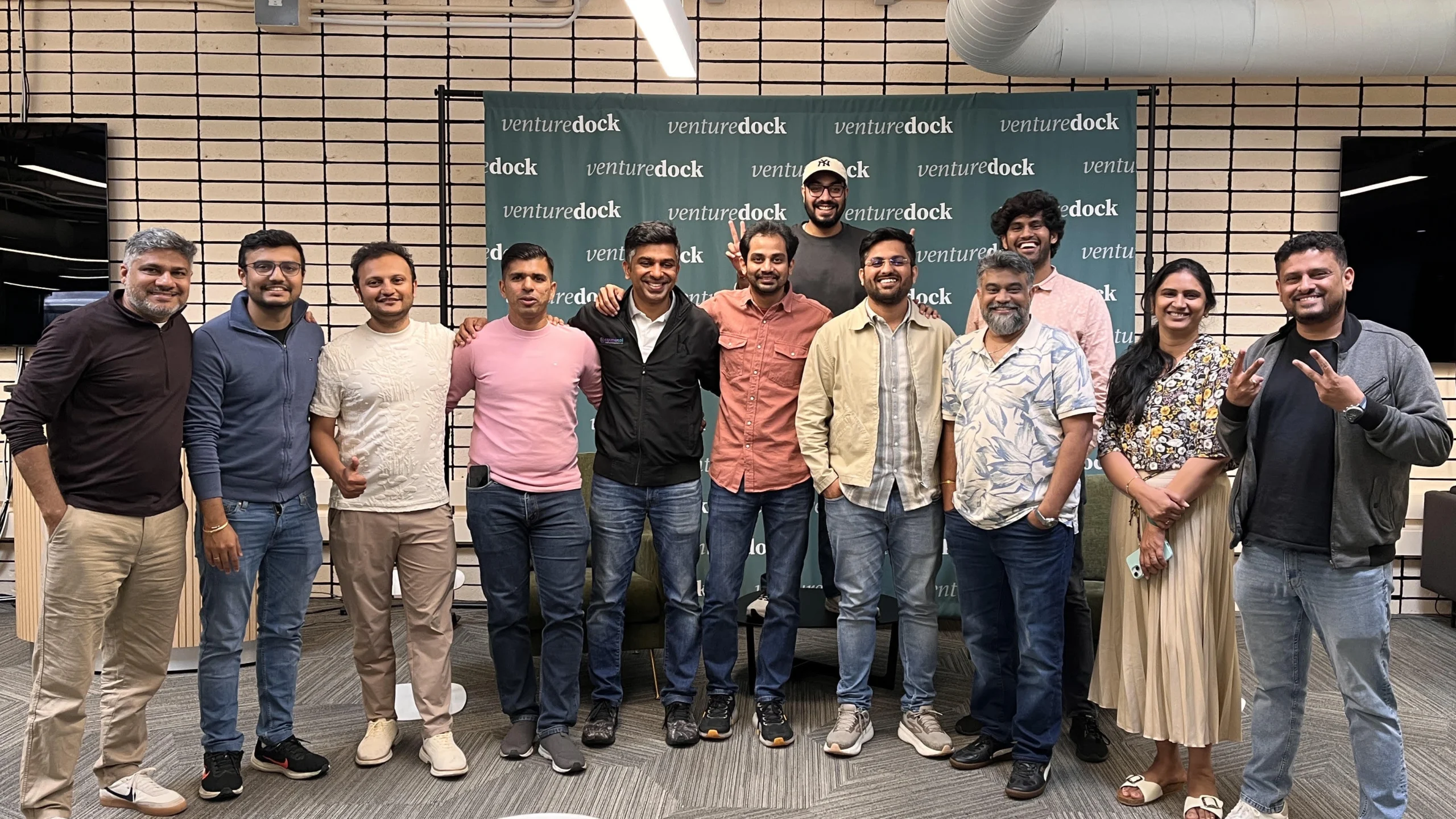
6 days. 22 speakers. 8 healthcare AI startups from India, sitting together in a room in the Bay Area, building for the US.
That was Vertical Velocity ’26, Cohort 2. And as I write this, I find myself still processing the sheer density of those days.
Between September 14-19, founders, operators and investors who have built and backed some of the most important healthcare companies in the US sat across the table from our founders.
There were no grand presentations. Just people opening up and giving the unvarnished truth about where the market is going, what incumbents will never build, what actually gets a health system to sign, and what kills companies in this space.
What struck me most throughout the week was the ambition in the room.
These founders weren’t asking, “Can we compete in the US?”
They were asking, “What does the $100M version of this look like?”
In many ways, that is the exact shift we started AIBoomi to make.
There was so much shared in those rooms. Our notebooks were full, and we were still going. Here are the 25 insights I’m taking away, through a healthcare lens:
On where the market is heading:
- US healthcare is a $5.5T market still running on pre-iPhone infrastructure. The biggest companies of the next decade will be operating layers for payer and pharma back offices.
- Regulation is the most reliable product roadmap. Medicaid cuts, ICD-11, price transparency: each creates funded work incumbents can’t absorb.
- Employers are becoming healthcare’s fourth player, designing plans directly and questioning the ~15% payers take as administrators.
- Longevity and senior care are the largest consumer health markets of the coming decade, riding the silver tsunami and a $180T wealth transfer.
- Insurance-covered AI therapy is the biggest new care-delivery model in mental health: ~$10/month vs ~$150/session.
- Self-pay health (aesthetics, derm, GLP-1, med spa) is one patient-wallet TAM, and it moves faster than reimbursed care.
- Peptides, GLP-1s and HRT are converging into a market that will need AI clinical guidance once the regulatory path clears.
- Government-paid populations are the overlooked scale: half of California’s births are on Medi-Cal, and Medicare non-adherence alone wastes $300–400B a year.
On the structural gaps waiting to be built:
- Specialty AI operating systems win where Epic won’t go narrow. Front and back office are open; clinical mid-office belongs to incumbents unless you own the full vertical stack.
- Own outcomes where incumbents structurally can’t. Epic hands configuration to health systems; it never owns results.
- The plumbing between visits is broken and valuable: referrals, intake, and closing the loop to the referring physician.
- High-value chronic specialties reward deep automation and premium pricing. Nephrology costs the system $50–80K per patient a year.
- Credentialing speed is the supply constraint of US care. Cutting hiring from 90 days to 7 increases provider supply directly.
- Healthcare data monetisation has gaps Epic doesn’t close, by disease, geography and data type. The friction is the valuation gap between owners and buyers.
- Individual-level risk pricing is unbuilt: a health credit score, and pharmacogenomics once testing drops to $20–30.
On how the winners will be built:
- Product is no longer the moat. Distribution, clinical trust, proprietary data and integration rights are. The real question: “how are we not roadkill to Claude or ChatGPT?”
- Outcome-based solutions-as-a-service is replacing licences. One founder landed a $38B health plan by quoting $750K against a $15M incumbent.
- Sell revenue creation, not headcount replacement. Labour-savings stories erode by year two.
- Agents that buy back attention beat agents that buy back time.
- Vertical healthcare SaaS becomes a fintech and services stack. Expect zero-subscription platforms monetising payments and RCM.
- Trust is now quantified: 95% accuracy to ship, domain-expert evals, and peer-reviewed outcomes instead of efficiency claims.
- Healthcare GTM is trust engineering, not persuasion. Ten lookalike customers is critical mass; one company reached ~$10M ARR with zero outbound.
- Distribution partnerships are the scaling path, and often the exit. Large platforms will acquire AI teams without distribution over mature revenue.
- Category windows have compressed from ~7 years to ~3. Five well-funded players closes a category.
- Compliance is product architecture, not paperwork: SOC 2 Type II, US data residency, single-tenant isolation, no training on customer data.
A huge thank you to every speaker who gave this cohort their time and their honesty, and to Venture Dock for hosting us all week.
And to the founders of 2care AI, CaresLink, Cosmasol, Diagna, EigenH AI, Mykare.ai, Propel, and Remina Care — thank you for showing up with the ambition this program was built for.
The week ended exactly the way it should: with founders who came in with questions leaving with a plan, a network, and a much bigger view of what they are building.
As I look back on those six days, I keep returning to one question I heard in the room:
“What does the $100M version of this look like?”
That, to me, is a higher standard of ambition.
And I hope we keep building rooms where more Indian founders feel ready to ask it.
Cohort 3 is coming soon. If you’re an Indian founder building AI for healthcare and the US is your market, keep an eye on this space.